Reviving a Declining Asset: +300% Organic Clicks in 11 Days
Aspect Health — April 2026 — content refresh sprint (single page, 11-day measurement window)
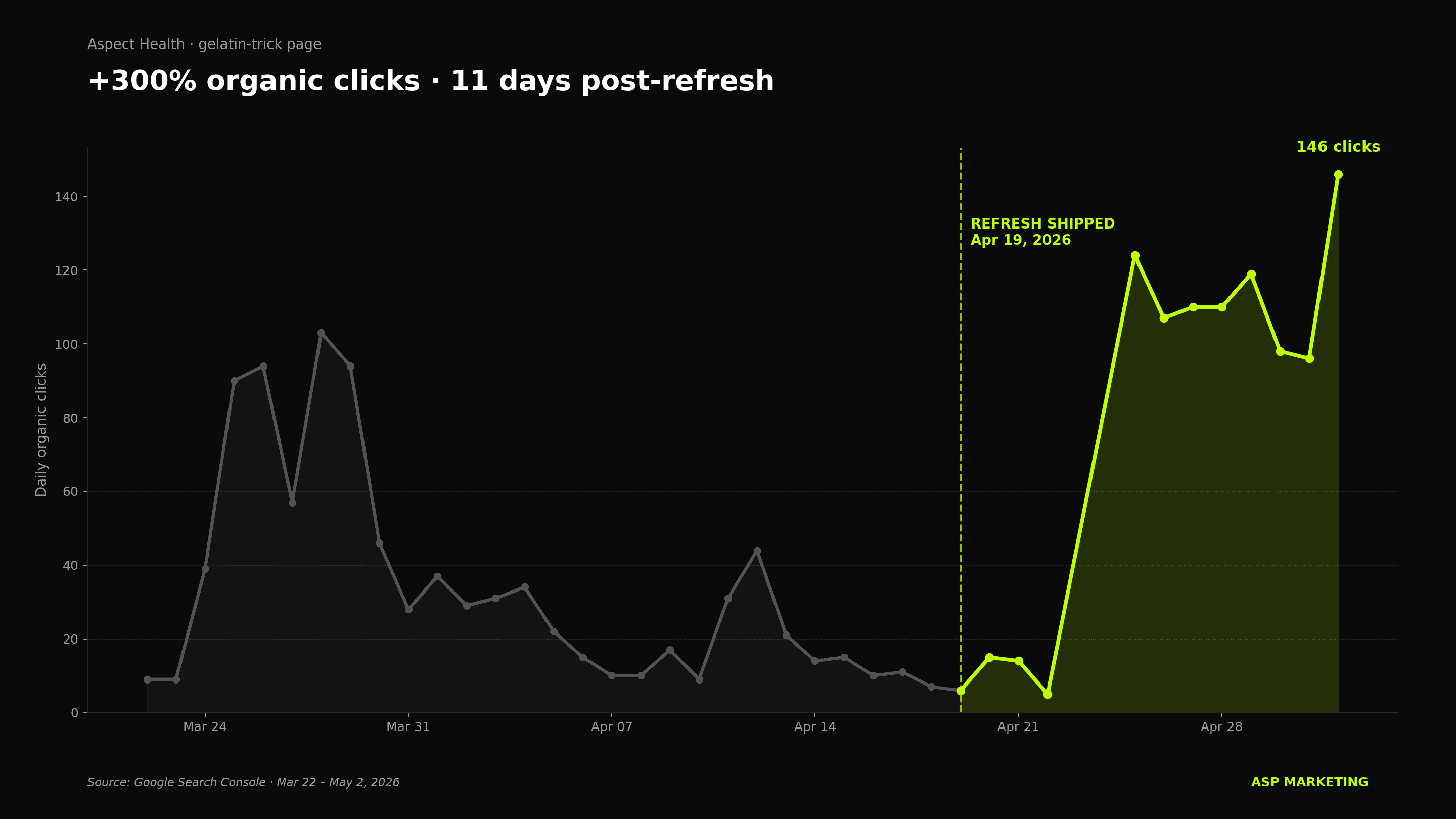
+300%
Organic clicks
236 → 944 clicks (14d before vs 11d after refresh)
+95%
Impressions
37,580 → 73,373 impressions
+105%
CTR
0.63% → 1.29% click-through rate
11 days
Time to recovery
Refresh shipped Apr 19 · 146 clicks on May 2 (24% above pre-decline peak)
The Challenge
What they were facing
Aspect Health is a venture-backed women's health platform focused on PCOS management — a free-CGM + behavioral-coaching subscription product. ASP runs SEO, content, Webflow, and analytics for the brand on a fractional CMO model.
Going into April 2026, a single article — "What is the gelatin trick for weight loss?" — was one of the main organic traffic drivers for the blog. Together with the adjacent fasting / wellness cluster, it represented a meaningful share of the site's monthly organic users.
Then, between April 5 and April 18, three things happened in succession:
- Daily clicks collapsed from a 90s/100s peak to single digits. By April 18 the page was earning 7 clicks on 1,366 impressions.
- Average position drifted from 4.4 to 10.3 — the page slipped off the first results page on its core queries.
- A Google algorithmic update landed in the late-April window, confirmed by parallel anomalies on adjacent pages in the same topic cluster.
The asset was hemorrhaging value. Continuing to do nothing meant losing it entirely — and with it, ~30% of the blog's organic users.
Our Solution
How we solved it
We don't refresh on instinct. Before any rewrite, we ran a structured five-input audit:
- GSC daily history — confirmed the decline was acute (post-April-5), not a long-term slide.
- GSC keyword-level data — the page was still ranking on the same queries (no targeting change), but with degraded position. Google had deprioritized it.
- SERP analysis (Ahrefs) — top-10 competitors had updated for 2026 with GLP-1-era framing (Ozempic, Mounjaro). Aspect's article was 14 months old, framed for 2024 wellness trends.
- EEAT audit — no visible MD/RD review line, no inline citations, no FAQ schema, no AIO answer block.
- Reader-pain re-validation — Reddit (r/intermittentfasting, r/loseit) sentiment surfaced three real reader pains the article didn't address.
Diagnosis: the page wasn't penalized for being wrong — it was demoted for being stale, thin on EEAT signals, and out of step with how 2026 readers ask the question.
- Title rewrite to lead with intent + freshness. Reframed from a definitional explainer ("what is / mechanism / effectiveness") into a decision aid ("what it is, how it works, and who it actually helps") with a 2026 freshness signal in the meta.
- AI-Overview answer block (≤60 words) placed immediately after the H1 — designed to match the structure of currently-cited AIO sources so a reader (or AI) can extract the headline answer in five seconds.
- 2026 GLP-1-era reframe. A new section addressing how Ozempic, Wegovy, and Mounjaro reshape the "do I need this trick?" question. Top SERP competitors had this; Aspect's older article didn't.
- Reader-pain section — three pains the previous version didn't address: "Will this stop hunger if I'm not on a GLP-1?", "How much do I actually take?", "Will I lose weight on this alone?" — each answered with explicit "yes, but here's the catch" framing drawn from the qualitative research, not generic blog handwaving.
- EEAT upgrade. Visible byline (Jessica Craig, NBHWC, CFNC, CFNS), medical reviewer line (Dr. Basma Faris, MD, board-certified OB-GYN), inline citations to peer-reviewed 2024–2026 research, new editorial hero image, refreshed
dateModified.
- Did not change the slug — preserves backlink equity.
- Did not change the published date — keeps the historical content-age signal.
- Did not over-add length — refresh is leaner, not longer (1,100 words vs. previous ~1,750). Stronger per-paragraph density.
- Did not change the canonical CTA — quiz funnel stays as-is.
- Did not chase new keywords — refresh lifts the existing targets, not new ones.
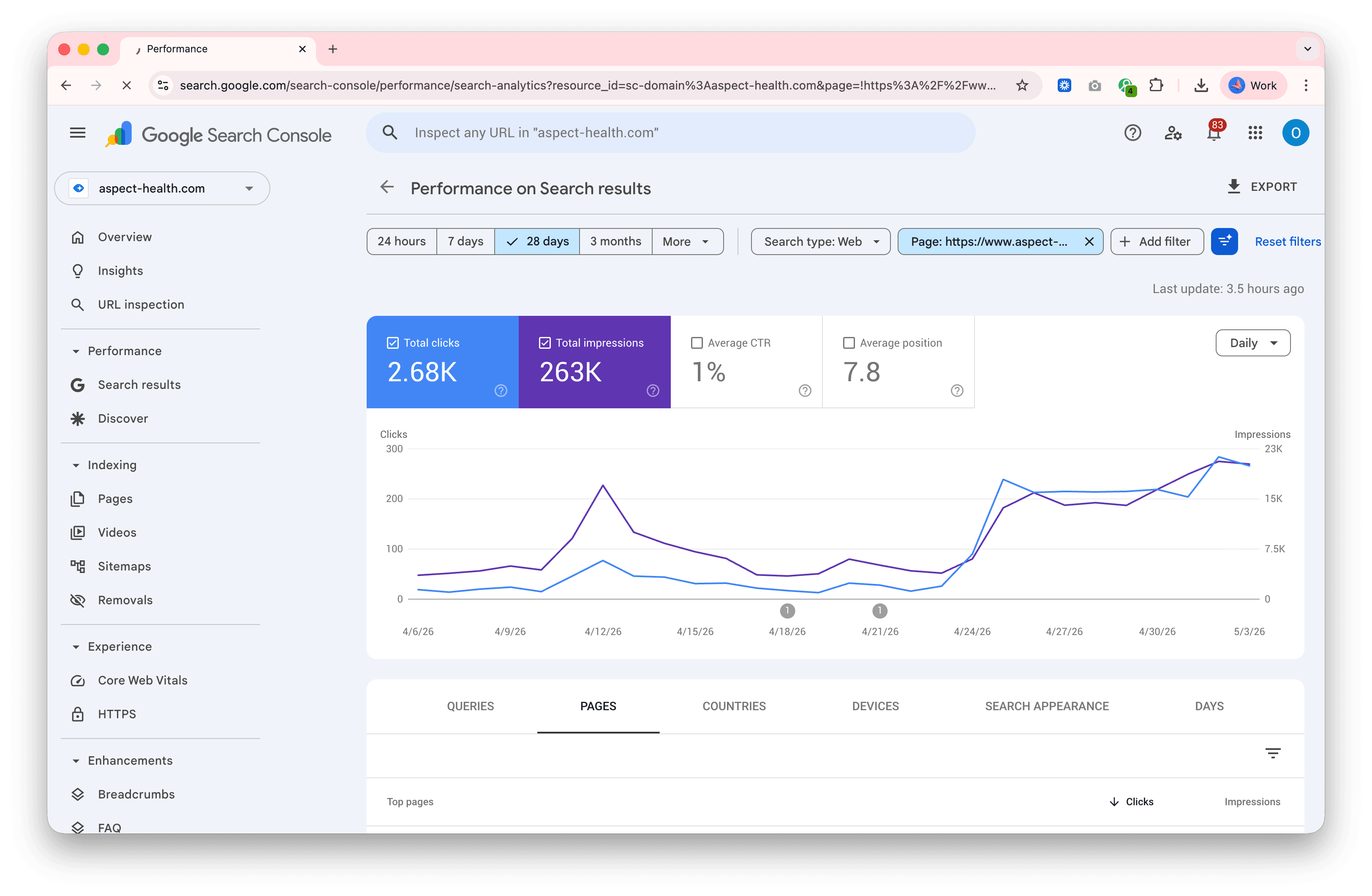
Why this matters: when a top-traffic page is in active decline, every day of delay is incremental loss. ASP's audit-to-ship cycle is designed to move from "we noticed it" to "we shipped a fix" inside 48 hours.
The intervention wasn't bespoke — it's the documented refresh playbook applied surgically:
- GSC trend scan — flag pages with >20% click decline over a rolling 14-day window.
- Diagnose the decline type — page-side (penalty / stale) vs SERP-side (new competitor / algo shift). Different diagnoses → different interventions.
- SERP competitor audit — what does the current top-10 have that you don't? What does no competitor have? (your differentiation hook).
- PAA + AI Overview harvest — every "People Also Ask" string becomes a candidate FAQ; the AIO answer block matches the structure of currently-cited sources.
- Reader-pain research — Reddit, Quora, AIO-cited forums. ≥3 pains the existing top-10 don't address well — that's the differentiation the page wins on.
- EEAT upgrade — visible MD/credentialed review for YMYL content; inline citations to ≥3 2024–2026 papers.
- Surgical edits, not full rewrites — preserve slug, dates, internal-link equity, CTAs. Change what's broken; keep what's working.
- Time-boxed measurement window — pre-defined 14d-before vs 14d-after baselines; commit to revert if the change underperforms.
- Algorithmic context matters. Google ran an update in the late-April window that affected this topic cluster. Some of the recovery is the algorithm settling. Our view: if the page is built right, it benefits from the update; if it's not, it suffers. The refresh made this page eligible for the recovery.
- Per-page outcomes are not uniform. Of three pages refreshed in the same April-19 batch, one was a +300% win (this one); two saw post-refresh decline tied to topical-narrowing of their titles. The playbook now flags "broaden, don't narrow" titles for stable-rank winners.
- GSC data lags 1–3 days. All numbers are point-in-time as of May 6, 2026. We continue tracking at +28d / +56d intervals.
- Single-page wins compound. This page is one of ~25 in the active refresh queue. The systemic win comes from the playbook, not any individual case.
If you have a high-traffic page that's losing ground — or 25 of them — we know exactly how to diagnose what's wrong and what to do about it.
Ready to achieve results like these?
Free 30-minute strategy call — no commitment, no sales pitch. Just actionable growth advice.
Get Your Free Strategy Session