B2B SEO Strategy: How to Drive Pipeline With Organic Search in 2026
 By Oleg Kovalev15 min read
B2B SEOO is a fundamentally different discipline from consumer SEO. The search volumes are lower, the keywords are more technical, the buying committees have multiple people, and a single conversion can be worth tens of thousands of dollars.
Yet most B2B companies approach SEO the same way an e-commerce brand would: chase high-volume keywords, publish generic blog posts, and hope for leads. That approach does not work when your buyer is a VP of Engineering researching solutions for six months before talking to sales.
This guide lays out the B2B SEO strategy we use at ASP Marketing to help SaaS and tech companies build organic search into a predictable pipeline channel. Every tactic has been tested across 30+ B2B engagements.
Why B2B SEO is different
Before building a strategy, you need to understand what makes B2B organic search unique:
Lower volume, higher value
A B2C keyword like "best running shoes" gets 100,000 searches per month. A B2B keyword like "enterprise data integration platform" gets 500. But that B2B searcher might represent a $200,000 annual contract. In B2B SEO, you are optimizing for revenue per keyword, not traffic per keyword.
Multiple decision-makers
B2B purchases involve 6-10 stakeholders on average. The end user Googles differently than the IT director, who Googles differently than the CFO. Your content needs to address each persona's search behavior and concerns.
Long consideration cycles
B2B buyers research for weeks or months. They read 13 pieces of content on average before contacting a vendor. Your SEO strategy must cover the full journey — from problem-aware to solution-aware to vendor-aware — not just the top of the funnel.
Technical and niche topics
B2B content requires genuine subject matter expertise. Surface-level posts written by generalist writers will not rank because they do not satisfy user intent. Google's E-E-A-T signals matter more in B2B than almost any other vertical.
The B2B SEO strategy framework
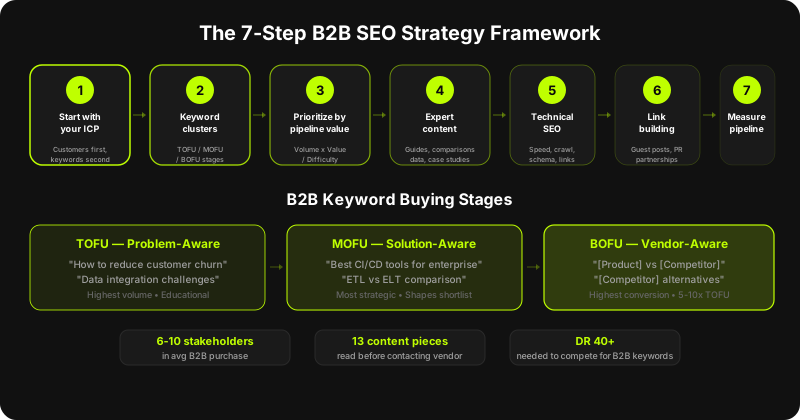
Here is our end-to-end framework, broken into seven components:
1. Start with your ICP, not with keywords
The biggest mistake in B2B SEO is starting with a keyword research tool instead of your customers. Before opening Ahrefs or SEMrush, answer these questions:
- Who is your ideal customer? — Industry, company size, revenue, tech stack, organizational structure.
- What are their top 3 pain points? — The problems that keep them up at night and drive them to search for solutions.
- What do they search before they know you exist? — Problem-aware queries ("how to reduce customer churn") that you can intercept.
- What do they search when evaluating solutions? — Comparison queries ("Salesforce vs HubSpot CRM") and category queries ("best customer data platform").
- What objections come up in sales calls? — Every objection is a content opportunity. "Is it worth switching from our current tool?" becomes a blog post.
Interview your sales team, review Gong calls, and study support tickets. These are your real keywords — the tool just validates the demand.
2. Build keyword clusters around buying stages
Map every keyword to a stage in the buying journey:
Problem-aware (TOFU)
The buyer knows they have a problem but does not know solutions exist. These are your highest-volume, most educational keywords.
- "How to improve developer productivity"
- "Why is our deployment pipeline slow"
- "Data integration challenges"
Solution-aware (MOFU)
The buyer knows solutions exist and is evaluating categories. These are your most strategic keywords — they shape which vendors make the shortlist.
- "Best CI/CD tools for enterprise"
- "Data integration platform comparison"
- "ETL vs ELT for real-time analytics"
Vendor-aware (BOFU)
The buyer is comparing specific vendors. These have the lowest volume but highest conversion rate.
- "[Your product] vs [Competitor]"
- "[Competitor] alternatives"
- "[Your product] pricing"
- "[Your product] case studies"
A balanced B2B SEO strategy allocates content across all three stages. Most companies over-index on TOFU and neglect the MOFU and BOFU content that actually drives pipeline.
3. Prioritize keywords by pipeline potential
Not all keywords are worth pursuing. We score every keyword opportunity using this framework:
Priority Score = (Monthly Search Volume × Business Value) ÷ Keyword Difficulty
Business value is scored 1-5:
- 1 — Pure awareness, no buying intent ("what is agile methodology")
- 2 — Problem-aware, mild intent ("how to reduce churn")
- 3 — Solution-aware, evaluating categories ("best analytics tools")
- 4 — Vendor-aware, comparing options ("Tool A vs Tool B")
- 5 — Decision-ready, high conversion ("[Product] pricing" or "demo")
This ensures you are not just chasing traffic but building a content portfolio that maps to revenue. Use the ASP SEO ROI Calculator to estimate the revenue impact of your keyword targets.
4. Create content that demonstrates expertise
B2B content must be genuinely useful and demonstrate deep expertise. Here is what works:
Long-form guides and frameworks
Comprehensive guides (3,000-5,000 words) that thoroughly cover a topic. These become pillar pages for your topic clusters and accumulate backlinks over time. This post is an example.
Comparison and alternative pages
"X vs Y" and "X alternatives" pages have the highest conversion rates in B2B SEO. Be honest — acknowledge competitor strengths and position your product for specific use cases. Authenticity converts.
Data-driven research
Original research — surveys, benchmark reports, industry analyses — generates press coverage and backlinks that no amount of blog posting can match. If you have product usage data, anonymize it and publish insights.
Technical deep-dives
In-depth technical content written by (or with input from) engineers and product experts. These rank well for technical queries and build credibility with technical buyers.
Case studies optimized for search
Most B2B case studies are buried in a resources section. Instead, optimize them for search: target keywords like "[industry] [use case] case study" and include quantified results in the title.
5. Nail technical SEO fundamentals
Before scaling content, ensure your technical foundation is solid:
- Site speed — Core Web Vitals in the green. LCP under 2.5s, CLS under 0.1, INP under 200ms.
- Crawlability — Clean URL structure, working XML sitemap, no orphan pages, proper robots.txt.
- Indexation — Self-referencing canonical tags on every page, no accidental noindex tags, proper handling of parameter URLs.
- Structured data — Article schema on blog posts, FAQ schema on FAQ sections, Organization schema on homepage, BreadcrumbList on all pages.
- Internal linking — Every page reachable within 3 clicks, pillar pages linked from supporting content, and vice versa.
- Mobile experience — Responsive design, readable text without zooming, tappable elements with adequate spacing.
Technical SEO is not glamorous, but fixing crawl issues and speed problems often produces the fastest ranking improvements.
6. Build authority through link acquisition
B2B websites typically need a Domain Rating (DR) of 40+ to compete for meaningful keywords. Link building strategies that work for B2B:
Guest posting on industry publications
Write for publications your buyers read. The link value is secondary to the credibility and referral traffic. Target 2-4 high-quality guest posts per month.
Digital PR with original data
Publish original research or benchmark reports, then pitch them to journalists and industry analysts. One viral data piece can generate 50-100 referring domains.
Resource page link building
Find pages that curate resources, tools, and guides in your industry. If your content genuinely belongs on those lists, reach out and suggest inclusion.
Strategic partnerships
Co-create content with complementary products, integration partners, or industry associations. These collaborations naturally generate cross-links and expand your audience.
Broken link building
Find broken links on relevant industry sites and offer your content as a replacement. This works especially well for older industry resources and guides.
7. Measure what matters: pipeline, not pageviews
The ultimate measure of B2B SEO success is pipeline contribution. Set up tracking at three levels:
Leading indicators (weekly)
- Keyword ranking positions for target terms
- Organic traffic by landing page
- New pages indexed
- Backlinks acquired
Engagement metrics (monthly)
- Time on page and scroll depth by content piece
- Pages per session from organic visitors
- Content downloads and gated asset conversions
- Email captures from organic traffic
Business impact (quarterly)
- Marketing Qualified Leads (MQLs) from organic search
- Sales Qualified Leads (SQLs) attributed to content
- Pipeline generated from organic visitors
- Revenue closed from organic-sourced opportunities
- Customer Acquisition Cost (CAC) from organic vs other channels
Build a dashboard that connects Google Search Console data to your CRM. This is the only way to prove — and improve — SEO's contribution to revenue.
Common B2B SEO mistakes
After running SEO programs for 30+ B2B companies, these are the patterns we see most often:
- Writing for search engines instead of buyers. If your content reads like it was written to rank rather than to help, it will not convert even if it does rank.
- Ignoring MOFU and BOFU content. Comparison pages and use-case content have 5-10x the conversion rate of awareness content. Most companies severely under-invest here.
- No internal linking strategy. Orphan blog posts do not build topical authority. Connect every piece to a pillar page and to related supporting content.
- Treating SEO as a project instead of a program. SEO compounds over time. Companies that invest consistently for 12+ months see dramatically better results than those who start and stop.
- Not involving subject matter experts. In B2B, the writer's expertise matters. Generalist content written without SME input will be outranked by competitors who involve their engineers and product teams.
- Optimizing for the wrong metrics. Traffic and rankings are vanity metrics if they do not translate to pipeline. Always tie SEO KPIs back to revenue.
B2B SEO timeline: what to expect
Realistic expectations for a well-executed B2B SEO program:
- Month 1-2: Technical audit, keyword strategy, and first content published. Quick wins from technical fixes may show early ranking improvements.
- Month 3-4: Initial ranking signals for target keywords. Content begins indexing and earning impressions.
- Month 5-6: Meaningful organic traffic growth. First leads from content. Link building efforts starting to compound.
- Month 7-9: Consistent traffic growth. Topic clusters reaching critical mass. Pipeline attribution becoming measurable.
- Month 10-12: SEO becoming a significant pipeline contributor. Organic CAC lower than paid channels. Compounding returns visible.
- Year 2+: SEO as a primary acquisition channel. Content moat that competitors struggle to replicate. Sustainable, compounding growth.
The key insight: B2B SEO is slow to start but compounds aggressively. The companies that win are the ones that stay consistent through the first 6 months when results feel slow.
Getting started with B2B SEO
If you are ready to build organic search into a pipeline channel, here is where to start:
- Audit your current state. Where do you rank? What content exists? What are the technical issues?
- Interview your sales team. What questions do prospects ask? What objections come up? What competitors are mentioned?
- Build 3-5 topic clusters. Map keywords to buying stages and prioritize by pipeline potential.
- Fix technical foundations. Site speed, crawlability, structured data, internal linking.
- Publish your first pillar page. One comprehensive, expert-level guide targeting your highest-priority cluster.
- Commit to consistency. 4-8 pieces of content per month, every month, for at least 12 months.
Or, if you want to skip the learning curve: our B2B SEO team has done this 30+ times. Book a free strategy call and we will show you exactly where the opportunities are in your market.
B2B SEO Strategy FAQ

Written by
Oleg KovalevFounder & Partner
Growth marketing leader. Ex CMO at Costa Coffee. Scaled 4 startups (2 acquired). Sequoia/a16z-backed. Grand Jury of Effie Awards. Techstars Mentor. Wharton & MIT Sloan.
Need help with your marketing?
Free 30-minute strategy call — no commitment, no sales pitch. Just actionable growth advice.
Get Your Free Strategy Session