

Most startup growth advice you read online is downstream of two missing pieces: a clear positioning that survives a customer interview and a funnel that's been tested instead of believed. Everything after that — the channel mix, the paid spend, the lifecycle, the brand work — compounds when the first two are right and disintegrates when they're not. This is the playbook I've used four times to take companies from "we have a product" to $3M ARR, and it's the framework I now run every fractional CMO engagement against.
I call it the 3M ARR Framework. It's a five-phase, 13-week operating roadmap I refined across Aspect Health (scaled profitably to $2.5M ARR in 9 months, secured Sequoia and Andreessen Horowitz investment), AdSkill, Skip.dev, and a handful of other portfolio engagements. The version I'm publishing today is the third major rebuild. It's not one-size-fits-all — every niche has its own bottleneck, and you'll adjust phase weights to your business — but the spine is stable. If you follow it honestly, you stop burning months on things that don't compound.
Below: the full framework, each phase with its 6 sub-tasks, what most founders get wrong inside each phase, a 13-week sequencing view, and the calibration notes I'd give myself if I started over today. This is the article I wish existed when I was running my first growth org.
Why "good product, bad budget" is the wrong diagnosis
Most startups I've seen fail don't fail from low budgets, bad products, or poor execution. They fail from wrong positioning. I'd put it at roughly 70% of the failed cap table I've watched up close — the team built something that worked for a real user, then targeted the wrong slice of the market, with the wrong message, against the wrong alternative. Everything they did after that was correctly executed marketing on a foundation that was off by 15 degrees, and 15 degrees compounds.
The remaining 30% split between funnel problems (cost-per-acquisition is too high because the funnel converts at 0.4% when it should convert at 2%) and retention problems (LTV is too low because the product fits but the experience doesn't keep users). What almost never causes failure: insufficient ad budget, lack of a brand book, missing a TikTok strategy. Those are second-derivative problems. The framework below is ordered the way I learned to debug them — first principles first, scale last.
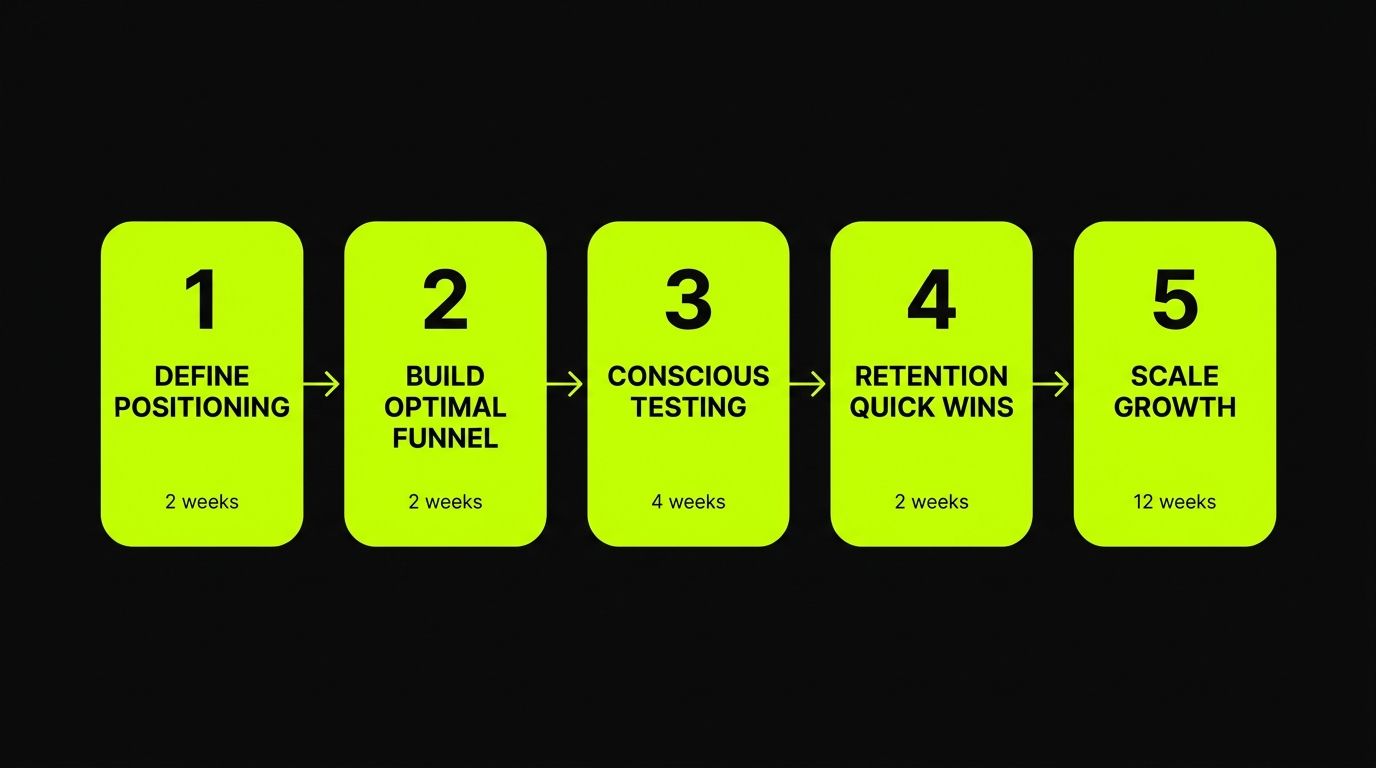
Phase 1: Define Positioning (2 weeks)
Almost every fractional CMO conversation I've had starts with "we need more leads." About half the time, the right answer is "you don't have a positioning problem with leads, you have a positioning problem upstream of leads." Phase 1 is where I make the founder spend two weeks looking honestly at who the product is for, what alternative the buyer is choosing instead of you, and whether the headline on the homepage is actually doing any work. Almost nobody likes this phase. The ones who run it properly are the ones who get to phase 5.
The biggest mistake I see in this phase is founders skipping the customer interviews because "we already know our customers." You don't, not until you've recorded 10 of them saying out loud what they thought before they found you. Aspect Health's positioning shift after this exercise was the single highest-leverage thing we did in the first 9 months — see what a fractional CMO does for the operating model behind that work.
Phase 2: Build an Optimal Funnel (2 weeks)
If your product solves a real problem but your acquisition cost is brutal, your funnel is the bug, not the channel mix. A common pattern: a founder spends six months testing five channels on a mediocre funnel and concludes "paid doesn't work for us." Then we rebuild the funnel and the same channel works. Phase 2 is about picking ONE high-conversion funnel and building it well, not running parallel mediocre ones across channels.
One pattern I learned the hard way: it's cheaper to build a great funnel for one channel and master that channel than to build three OK funnels for three channels. Concentration is a feature in phase 2, not a bug.
Phase 3: Conscious Testing (4 weeks)
After phases 1 and 2, what you have is not a strategy. What you have is a set of hypotheses about a positioning, a funnel, and the ICP it converts. Phase 3 is where you build the engine to test those hypotheses at speed without burning cash on every guess. The phase length (4 weeks) reflects how much execution this actually takes — most teams skip the engine-building and just "run tests," and the tests they run are slow, contaminated, and uninterpretable.
The cultural shift this phase requires is bigger than the operational one. Founders who came up shipping product features sometimes treat growth tests like product launches — "we're testing X on May 1." That's a launch, not a test. A test has a hypothesis, a metric, a sample size, and a kill criterion before it runs. If any of the four is missing, you'll learn nothing.
Phase 4: Retention Quick Wins (2 weeks)
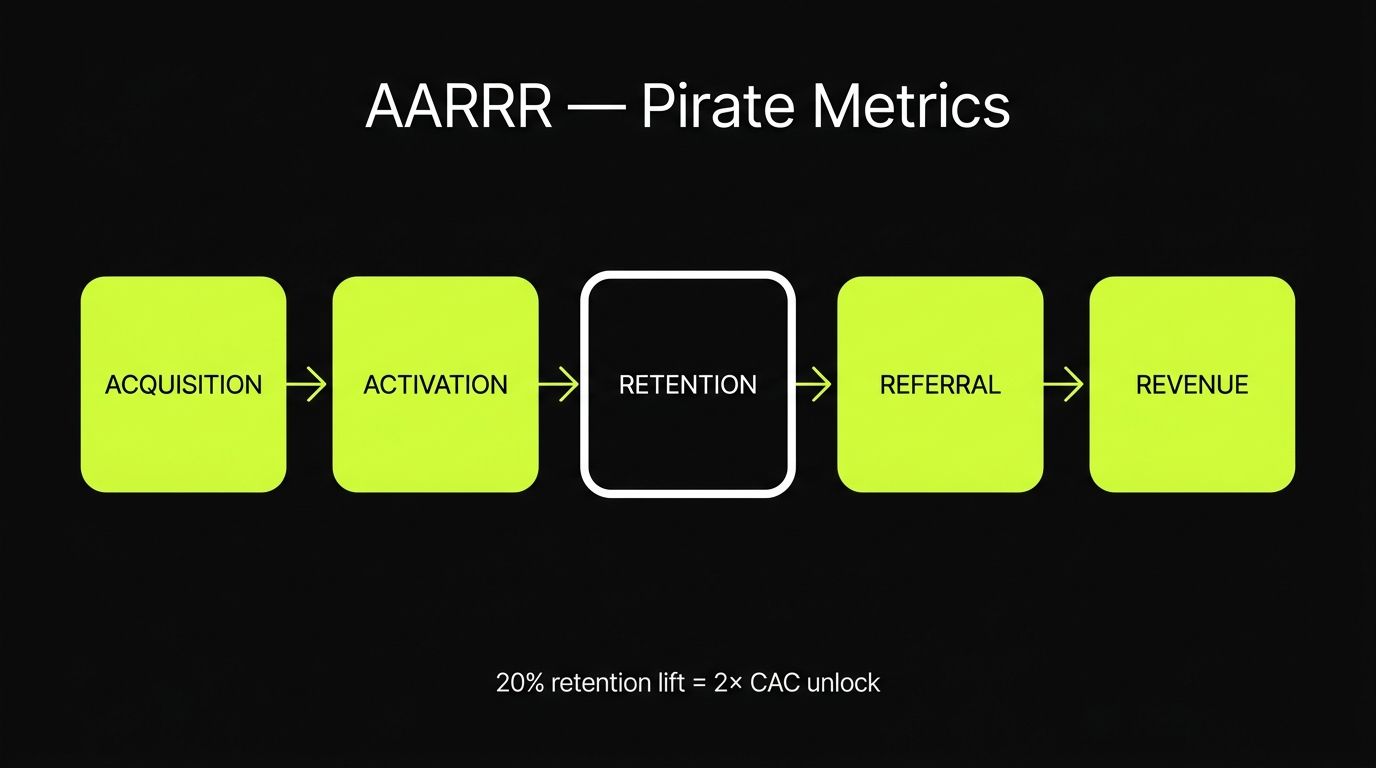
The math of scaling is simple: bigger LTV lets you spend more on CAC, which lets you scale faster. Phase 4 is where most teams under-invest because retention work feels less glamorous than acquisition work. But a 20% lift in 6-month retention can unlock a doubling of your acceptable CAC overnight, which means the channels you couldn't afford yesterday become viable today. Two weeks here, run honestly, can be worth six months of acquisition optimization.
Phase 5: Scale Growth (3 months)
This is the phase every founder wants to start with. It's the longest phase (3 months) and the one most likely to be wasted if phases 1–4 weren't run honestly. The right scaling techniques are the ones that worked for me at Aspect Health: a small set of channels chosen by math, a forecast for what each channel could deliver at saturation, a scaling engine that knows the difference between linear and non-linear scale, and gradual goal escalation so you don't break what's working.
The Aspect Health scale phase was driven by two channels: paid social with a tightly-positioned ICP-specific creative library and partnership channels with health-network operators. That was it. We didn't scale six channels — we scaled two, and we scaled them carefully. The result was profitable growth to $2.5M ARR in 9 months and the Sequoia / Andreessen Horowitz round that followed. The phase 5 work was disciplined, not magical.
Why I rebuilt this framework four times
The first version of this framework was a Google Doc I wrote after my first growth org. It was wrong in ways I didn't see until I tried to apply it to a different company in a different niche. The current version (version 3) is the one I'd hand a founder today, with one caveat: every niche has a phase that's heavier than the others, and the founder who treats the timing as gospel will mis-allocate effort.
The 13-week sequencing at a glance
This is the version I tape to the wall during the first month of every fractional CMO engagement. Two weeks of positioning, two weeks of funnel, four weeks of testing, two weeks of retention, twelve weeks of scaling — overlapping, not strictly linear. Scale work overlaps with later testing. Retention experiments compound through scaling. The boundaries are decision moments, not handoffs.
What I'd change if I started over today
Three things I got wrong in earlier versions. I'd integrate AI tooling into phase 3 from day one — the testing-engine architecture I describe above was built before LLMs were a serious part of the operating layer; today I'd use Claude or GPT-5 to draft hypothesis sets, summarize customer interviews from transcripts, and prioritize the testing backlog by ICE score before the founder review. Phase 3 throughput would 2–3× with the same headcount.
I'd compress phase 1 from 2 weeks to 10 days for second-time founders. Repeat founders have positioning instincts the framework over-indexes against. Keep the customer interviews, drop the competitor mapping if they've already lived the category. For first-time founders, keep the full two weeks — they need the forcing function.
I'd add a phase 0: a one-week pre-flight that asks the brutally honest question of whether the company has product-market fit at all. The framework assumes PMF. If you don't have PMF, no growth roadmap fixes it — and I've watched too many founders run growth playbooks before fixing PMF, which is the most expensive way to lose 6 months. The Sean Ellis startup pyramid test (40% "very disappointed" if you went away) is the gate. Below 40%, go back to product. Above 40%, run the framework. The pre-flight is the cheapest week you'll ever spend.
How to use this if you're a founder reading this cold
Three options. If you want to run it yourself: print the 13-week cadence, block weekly founder time, and find one specialist freelancer per channel by week 5. The framework works without a fractional CMO if the founder commits weekly hours to it. The risk is the founder underestimating phase 1 and 3 effort and giving up at week 6.
If you want a sparring partner: hire a senior advisor at $1,000–$2,000/month and run a 30-minute weekly check-in against the framework. Cheaper than a fractional, slower than a fractional, but works for founders who'd rather drive the bus than hand the keys over. Read fractional CMO for startups for the gate-test on when this becomes the right move.
If you want me to run it with you: our contact page is the cleanest way to start. I'll either tell you the framework fits and walk you through what an engagement at your stage would look like, or tell you that you're not in the right phase yet and what to do instead. Both are honest answers. Our fractional CMO services page has the engagement structure, and the broader portfolio context is at our B2B SaaS marketing agency page.
Frequently asked questions about the 3M ARR Framework
What is the 3M ARR Framework?
The 3M ARR Framework is a five-phase, 13-week growth operating roadmap I refined across Aspect Health, AdSkill, Skip.dev, and other portfolio engagements. The five phases are: define positioning (2 weeks), build an optimal funnel (2 weeks), conscious testing (4 weeks), retention quick wins (2 weeks), scale growth (3 months). It's designed to take an early-stage startup from "we have a product" to $3M+ ARR by sequencing the work in the order it actually compounds rather than the order it feels exciting.
Has the framework actually been used to get a company to $3M ARR?
Yes — most directly at Aspect Health, where the same playbook scaled the company profitably to $2.5M ARR in under 9 months and was the operating roadmap that supported the Sequoia and Andreessen Horowitz investment round. I've since applied versions of it at AdSkill, Skip.dev, and additional portfolio engagements. The framework gets adjusted to each niche — B2B SaaS weights phases differently from consumer subscription or marketplace — but the phase order is stable.
Can a founder run this without hiring a fractional CMO?
Yes. The framework is designed to be executable by a committed founder with 5–8 weekly hours and one specialist freelancer per channel from week 5 onward. The risk is honesty: founders under-invest in phase 1 (positioning interviews feel slow) and phase 3 (testing engine feels unsexy). If you can hold the line on both, you don't need a fractional CMO to run it.
Why is positioning phase 1 instead of acquisition?
Because 70% of failed startups I've watched closely failed from positioning, not acquisition. Spending $50K on paid ads against the wrong ICP with the wrong message is a faster way to burn cash than not spending at all. Positioning compounds — every downstream channel inherits its quality. If you start with acquisition, you're optimizing the wrong layer.
How is this framework different from Lean Startup or Pirate Metrics?
Lean Startup is a product-iteration philosophy; this is a growth operating roadmap that assumes a product exists. Pirate Metrics (AARRR) is a measurement framework that lives inside this one — I use it specifically in phase 4 for retention analysis. The 3M ARR Framework is the sequencing and decision logic that connects ICP work to scaling — the operating layer those frameworks don't provide.
What if my company is already past $3M ARR — is this still useful?
Often yes, as a diagnostic. Companies past $3M ARR that have stalled growth almost always have a phase-1 or phase-2 problem they never fully solved — positioning has drifted because the ICP changed, or the funnel was built for a smaller scale. Running the framework as a 4-week audit (compressed timing) surfaces the bug. Companies past $10M ARR usually have a phase-5 constraint problem (sales capacity, creative refresh velocity, support throughput) that the framework also addresses.
How long does the framework actually take in practice?
The nominal 13 weeks is the disciplined version. In practice, most companies stretch it to 16–20 weeks because phase 1 customer interviews take longer than expected and phase 3 testing produces more rework than the plan allows. Plan for 13 weeks, expect 18. Companies that compress below 11 weeks usually skipped customer interviews — and pay for it in phase 5.
What do you mean by "self-roast technique" in phase 2?
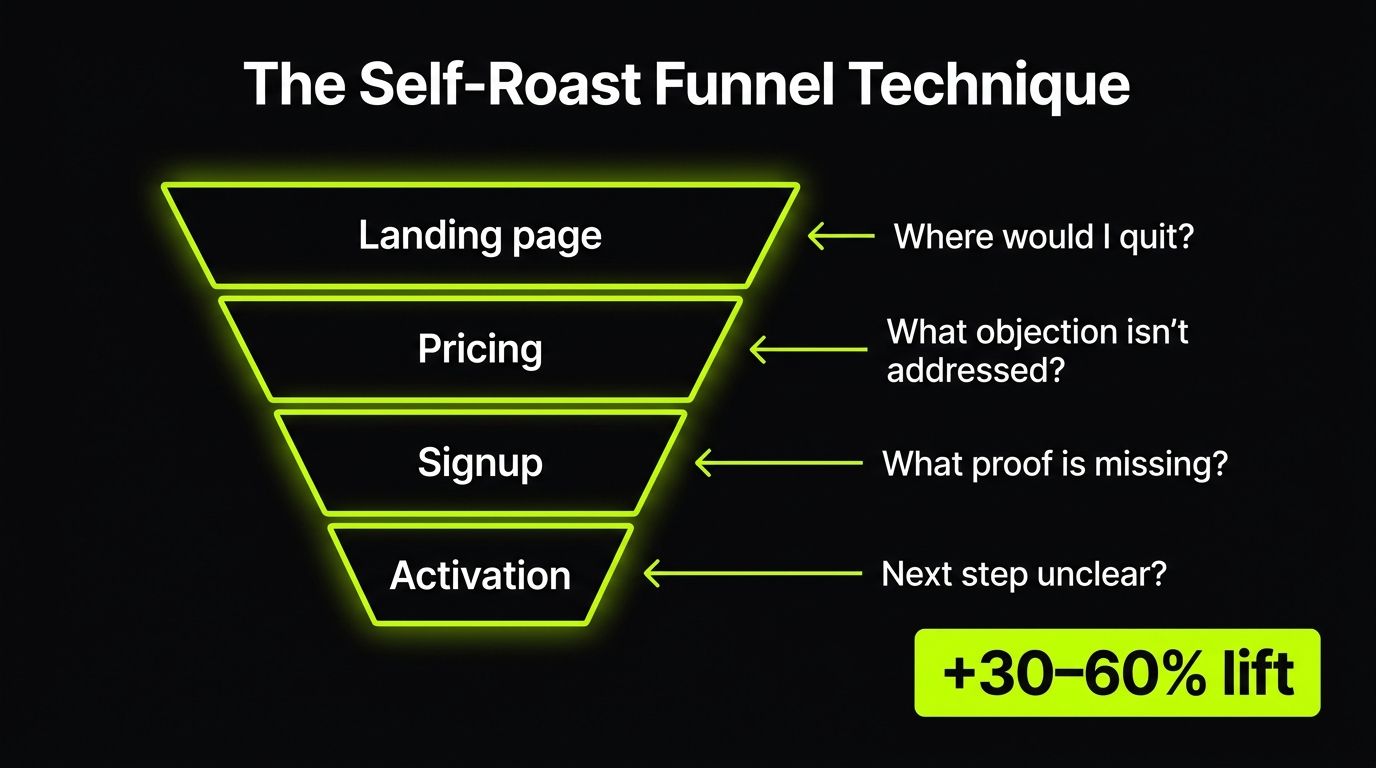
After building a funnel, walk through it as an ICP-shaped buyer who is actively skeptical. At every step, write down: where would I quit, what objection isn't addressed, what proof element is missing, what's unclear about the next step. Then fix every roast before the funnel goes live. The technique reliably lifts conversion 30–60% in my experience — and the reason it works is that founders are too close to their own funnel to see the friction. Forced skepticism is the cheapest UX research you'll ever do.

Written by
Oleg KovalevFounder & Partner
Growth marketing leader. Ex CMO at Costa Coffee. Scaled 4 startups (2 acquired). Sequoia/a16z-backed. Grand Jury of Effie Awards. Techstars Mentor. Wharton & MIT Sloan.
Need help with your marketing?
Free 30-minute strategy call — no commitment, no sales pitch. Just actionable growth advice.
Get Your Free Strategy Session