Medical SEO Services: What Healthcare Providers Need to Know in 2026
 By Oleg Kovalev14 min read
Why Medical SEO Services Exist as a Distinct Category
If you're a physician, clinic owner, or health-tech founder searching for "medical SEO services," you already suspect that generalist marketing agencies don't quite get it. You're right. Medical SEO is a separate discipline for the same reason cardiology is separate from general practice — the stakes, the rules, and the patient-trust dynamics make the work fundamentally different.
Google classifies medical content as YMYL — "Your Money or Your Life" — the highest scrutiny tier in search. Which means every recommendation about symptoms, treatments, medications, or providers has to meet a higher bar for author credentials, editorial review, source citation, and factual accuracy than a generic business blog. Pair that with HIPAA-adjacent marketing constraints, local SEO complexity (patients rarely travel far), and insurance-plan competition, and you get a surface where shortcuts get punished faster than in almost any other vertical.
This guide walks through what medical SEO services actually cover, what you should expect to pay, what separates a competent healthcare SEO agency from a generalist with a wellness logo, and how to scope an engagement that moves new-patient volume — not just keyword rankings.
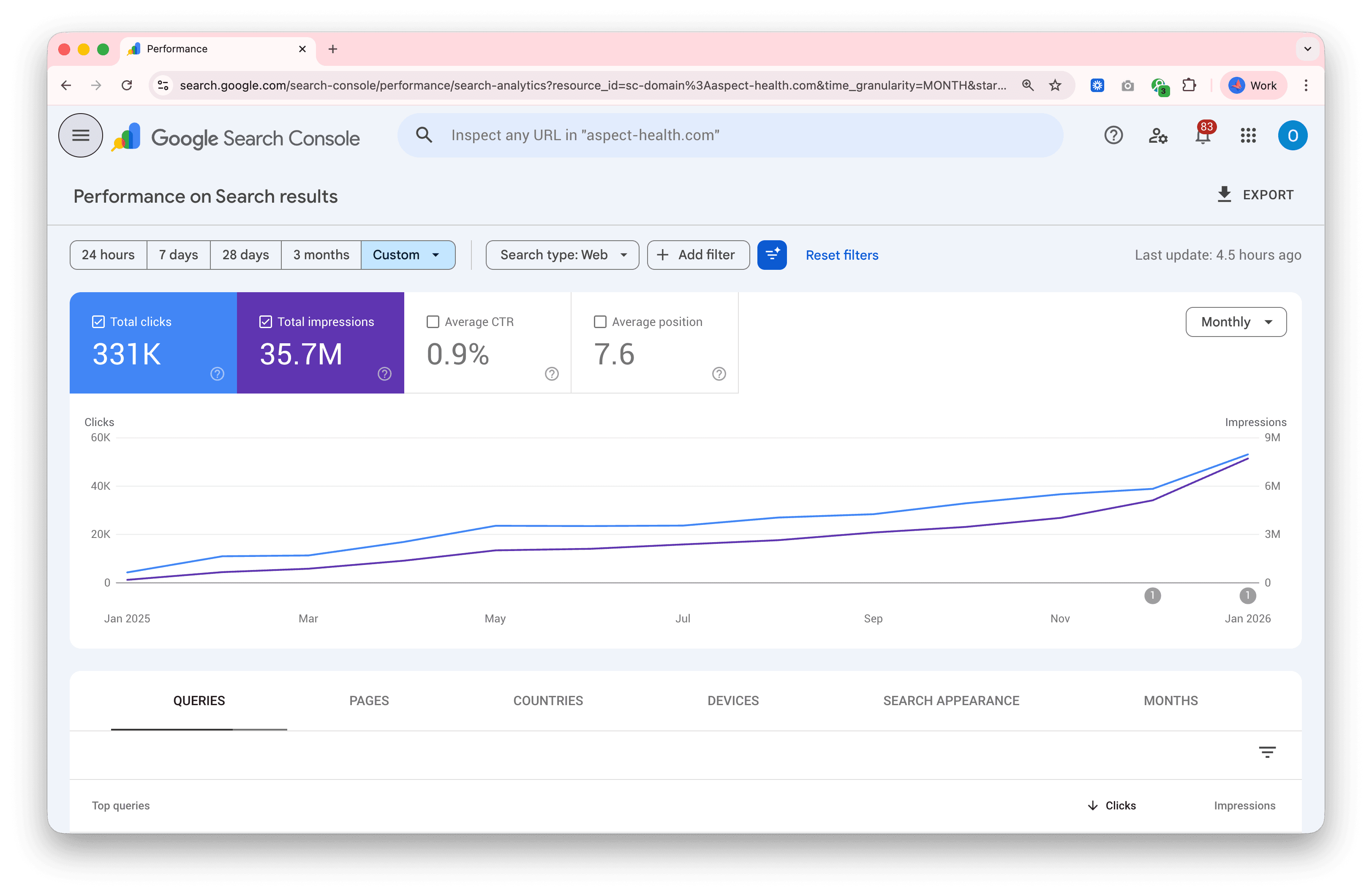
One thing worth saying up front, since you're about to be on the buy side of a medical SEO engagement. I'm Oleg Kovalev — I run ASP Marketing. I've personally owned SEO for multiple health and wellness platforms, including Aspect Health (women's health), where we grew organic search from roughly 1,000 to ~60,000 monthly clicks in about a year — 331,000 clicks and 35.7M impressions across the period, average position 7.6. The screenshot below is the actual Google Search Console performance for that engagement. When I describe what a competent medical SEO services partner should do later in this guide, I'm describing what actually produced that outcome — not an agency-deck wishlist.
What Medical SEO Services Actually Include
"Medical SEO" is a bucket term. Real engagements break into six distinct workstreams, and a competent healthcare SEO agency should be explicit about which of them are in scope.
A vendor who only sells workstreams 1 and 4 is a generalist SEO for doctors bolt-on. A real medical marketing SEO partner integrates all six and can show you how each connects to appointment bookings.
The YMYL / E-E-A-T Problem That Breaks Generalist Agencies
Google's December 2022 update added the second "E" — Experience — to E-A-T, and the guidance specifically called out medical content. Real-world clinical experience matters. Author credentials matter. Reviewer signatures matter. This is the single biggest reason generic SEO agencies fail in healthcare: their playbook assumes anyone can write about anything as long as the keyword research is good.
Practical implication: every piece of medical content you publish needs a real licensed author (MD, DO, NP, PA, RD, LCSW — whatever is relevant to the topic), a named medical reviewer, a "last reviewed on" date, and citations to primary sources — not to healthline.com. A vendor who won't build this workflow is wasting your money on content that will sit on page 4.
Local SEO: The 50% of Medical Marketing Most Agencies Fumble
For almost every clinic, dentist, chiropractor, specialist, or group practice, local search is the dominant organic channel. Patients search "dermatologist near me" or "best pediatrician [city]" — not "how dermatology works." If your local SEO is broken, your content SEO can't save you.
Core local SEO workstreams a competent healthcare SEO agency will run:
- Google Business Profile: fully filled, weekly posts, Q&A monitored, photos refreshed, services listed with descriptions, appointment links validated, insurance plans noted where relevant.
- Review acquisition systems: automated request flows after appointments (HIPAA-compliant — no PHI in messages), response templates for negative reviews, aggregated rating monitoring across Google, Healthgrades, Zocdoc, Vitals.
- Location pages: for multi-site practices, a unique page per location with embedded map, specific staff, hours, insurance accepted, parking/transit info, condition pages localized to each location.
- Citation building & cleanup: Healthgrades, Zocdoc, Vitals, WebMD, Doximity, RateMDs, plus the general directories. Consistent NAP, claimed profiles, correct specialties.
For context on how local SEO connects to broader strategy, see our guide to choosing an SEO agency for small businesses — the evaluation framework translates directly to medical practices.
What Medical SEO Services Cost in 2026
Healthcare SEO commands premium pricing — average CPC of $10 on "medical seo services" isn't an accident. The audience is high-value, compliance requires specialist expertise, and the content workflow is heavier. Here's what fair pricing looks like across practice sizes.
Project-based alternatives: a medical SEO audit runs $3K–$8K; a local SEO + GBP sprint runs $4K–$10K; a clinical content library build (30–60 authored pages) runs $15K–$60K depending on depth.
If a vendor pitches medical SEO services at $300–$800/mo, what they're actually selling is citation submissions and some AI-generated fluff content. It won't rank and it may create compliance liabilities. The math on real medical SEO simply doesn't work under $1,500/mo.
Want to project ROI on a $5K–$12K retainer against expected new-patient acquisition? Run the numbers through our SEO ROI calculator — we've validated the model against 20+ healthcare client engagements.
Red Flags and Green Flags When Choosing a Medical SEO Agency
Every week, clinic owners sign with agencies that will damage their rankings and, in some cases, create HIPAA exposure. Here's the heuristic to avoid that.
- Guarantees "page 1 rankings in 30–60 days"
- Won't sign a Business Associate Agreement (BAA) if they touch any analytics or form data
- No licensed clinicians in their content production or review workflow
- Proposes one generic landing page per service instead of condition / treatment depth
- Ghostwrites content with no author byline or review signature
- Uses Google Analytics or Meta Pixel without discussing PHI exclusion (this is the single most common HIPAA marketing violation)
- Pushes paid-only strategy because they don't know how to rank organically in medical
- Healthcare is "one of many verticals" they serve with the same playbook
- Shows healthcare-specific case studies with new-patient volume, not just rankings
- Has a standing roster of MD/DO/NP reviewers or an editorial partnership with clinicians
- Talks about HIPAA, BAAs, and PHI handling unprompted in the first call
- Uses server-side analytics, PHI-safe form handlers, consent-mode implementations
- Knows LegitScript for paid healthcare advertising
- Publishes their own review-by workflow, editorial calendar, fact-check process
- Understands insurance-plan and telehealth dynamics in your niche
- Will turn down scope that won't work (e.g., a brand-new clinic asking for national SEO)
Questions to ask on the first call
- What's your process for getting medical content clinically reviewed before it publishes? They should have a named roster of reviewers and a signed SLA, not "we'll find someone."
- How do you handle PHI in analytics and advertising? Correct answer includes server-side tagging, GA4 consent mode, Meta Conversions API with PHI hashing, and signed BAAs with any vendor that touches form data.
- Show me a medical client's traffic and appointment-volume trajectory over 12 months. Not screenshots of rankings — real pipeline or practice-management data.
- How do you build schema for a MedicalClinic with multiple Physicians and Services? If they can't answer in technical detail, they've never done it.
- What's your stance on AI-generated medical content? Acceptable: "AI-assisted research and drafting, human clinician review on every page." Unacceptable: "we use AI for volume."
- Who's on my account and how many hours do they personally work on it? You want a named senior lead, not rotating juniors.
What to Expect from a Medical SEO Engagement
Engagements that move new-patient volume follow a consistent arc. Here's what the first year should look like.
12-month medical SEO engagement
- Technical audit, HIPAA analytics review, compliance gap list
- Google Business Profile overhaul, citation cleanup, review-acquisition system live
- Keyword map: local + service + condition + informational clusters
- Competitor audit across the local practice set and national authority sites
- Editorial calendar + clinician reviewer roster locked in
- First 10–15 clinical content pieces live, clinician-reviewed
- Location pages rebuilt for all sites, structured data deployed
- Local pack rankings showing movement; reviews flowing consistently
- Condition-specific landing pages start ranking for long-tail "[condition] [city]" queries
- First measurable lift in appointment-request form submissions from organic
- Clinical content library hits 40–60 pages, ranking for high-intent terms
- Digital PR earning links from news and industry publications
- Symptom and treatment pages picking up AI Overview + featured-snippet placements
- Paid + organic blending — SEO data informing which paid campaigns to scale
- Reporting ties organic work directly to new-patient acquisition cost
If you're not seeing local pack movement by month 4 or appointment-request lift by month 6, something is broken in the execution. For a framework on connecting SEO work to revenue see how to measure SEO ROI.
Build In-House, Hire Agency, or Hybrid?
How ASP Marketing Approaches Medical SEO
We work with healthcare providers and wellness brands as part of a broader SEO practice — not as a vertical-specific agency but as a team that has done the work and respects the rules. Our approach:
- Clinician-reviewed content only. We don't publish medical content without a named licensed reviewer on the byline. We maintain a roster of reviewers across specialties through a partner editorial network.
- HIPAA-aware tech stack. Server-side analytics (GA4 + Cloudflare), PHI-safe form handlers, Meta Conversions API with proper hashing, signed BAAs on every tool that touches patient-adjacent data.
- Local + content + authority in one program. We don't sell "just local" or "just content" — the three workstreams compound only when they're integrated.
- Pipeline-linked reporting. Every monthly report ties organic work to new-patient form fills, calls, and when we have practice-management integration, booked appointments.
Case study reference: we helped an ERP SaaS client scale from near-zero to 6× organic traffic growth using this same compounding strategy — local and vertical expertise plus content authority. The medical SEO framework transfers directly.
Also relevant if you're evaluating broader strategy: AI SEO agency guide covers how we use AI for research and drafting (without letting it touch unreviewed clinical content), and SaaS SEO covers the software-company playbook that health-tech platforms can adapt.
If you run a clinic, group practice, or health-tech company and want an honest assessment of your current SEO — free, no retainer pitch — book a 30-minute scoping call. We'll tell you what's working, what's broken, and whether medical SEO services are the right investment right now or whether a different lever would move more patient volume for less money.
Medical SEO Services FAQ
What are medical SEO services?
Medical SEO services are a specialized form of search engine optimization built for healthcare providers and health-tech companies. They cover local SEO for clinics, clinician-reviewed content production (meeting Google's YMYL and E-E-A-T standards), HIPAA-aware marketing technology, medical schema markup, reputation management, and integration with paid healthcare advertising. The goal is to increase new-patient acquisition through organic search while staying compliant with HIPAA, HHS guidance, and state telehealth rules.
How much do medical SEO services cost?
Solo practices and single clinics typically pay $1,500–$4,000 per month. Multi-location specialty groups pay $5,000–$12,000 per month. Health systems and telehealth SaaS companies pay $15,000–$40,000+ per month. Vendors quoting under $1,500/mo are usually selling citation submissions and AI-generated content that won't rank and may create compliance risk.
How is healthcare SEO different from regular SEO?
Three core differences: (1) Medical content is Google's highest-scrutiny YMYL category and requires licensed clinician authors or reviewers to rank; (2) Local search dominates — most medical queries have "near me" intent, so Google Business Profile and local pack optimization often matter more than blog content; (3) HIPAA constrains marketing technology — most generalist agencies unintentionally violate PHI rules through Google Analytics, Meta Pixel, or form handlers without signed BAAs.
Is SEO for doctors worth it in 2026?
Yes, especially for single-specialty practices, elective-procedure clinics, and multi-location groups where new-patient acquisition cost from paid search is $200+. A competent 12-month medical SEO engagement typically cuts acquisition cost by 40–60% once the compounding effect kicks in around month 6–9. The practices where SEO is not worth it are those operating in hyper-commoditized markets with no differentiated services.
How long does medical SEO take to work?
Local SEO wins (Google Business Profile, reviews, local pack movement) show in 60–90 days. Content-driven rankings for condition and treatment pages take 4–8 months. Full compounding — where organic becomes your dominant new-patient channel — typically arrives between months 9 and 12. If a vendor promises material results in 30 days, they're either running paid ads or gaming metrics you shouldn't care about.
Do I need HIPAA-compliant analytics?
If your website collects any information that could identify a patient (name + condition, appointment requests, contact forms tied to a specific practice), then yes — and most medical sites do. This means server-side analytics, consent-mode implementations, Business Associate Agreements with tools that touch form data, and exclusion of PHI from advertising pixel payloads. HHS guidance in 2023 and 2024 made clear that standard Google Analytics and Meta Pixel setups on medical sites can be HIPAA violations. A real healthcare SEO agency handles this by default.
Ready to move forward? Get in touch — we'll audit your current medical SEO, flag any compliance issues, and tell you honestly whether a retainer makes sense for your stage.

Written by
Oleg KovalevFounder & Partner
Growth marketing leader. Ex CMO at Costa Coffee. Scaled 4 startups (2 acquired). Sequoia/a16z-backed. Grand Jury of Effie Awards. Techstars Mentor. Wharton & MIT Sloan.
Need help with your marketing?
Free 30-minute strategy call — no commitment, no sales pitch. Just actionable growth advice.
Get Your Free Strategy Session